Introduction
FDA alerts show counterfeit Ozempic has reached US supply channels. Learn what the numbers mean, how to check a source, and what to do next.
The numbers worth knowing
- December 21, 2023 - First major FDA alert
- Sterility could not be confirmed - Needle concern in 2023
- Several hundred units - 2025 suspected supply
- Dozens of units - Later 2025 seizure
- 990 - Compounded semaglutide reports
- More than 730 - Compounded tirzepatide reports
- About 5% - Online pharmacy compliance
- $299 to $449 monthly - Zepbound self-pay access
What FDA has confirmed
FDA's December 2023 alert said that thousands of counterfeit 1 mg Ozempic units had been seized from the legitimate US supply chain. The agency found counterfeit needles and could not confirm their sterility. That creates a possible infection risk separate from uncertainty about what is inside a pen. In April 2025, FDA said it had been notified that several hundred counterfeit 1 mg Ozempic units were in the supply chain and seized the identified products on April 9. In December 2025, it reported another counterfeit 1 mg Ozempic finding involving dozens of units and lot PAR1229. That lot number was authentic, which is why a lot-number match by itself is not proof that a product is real. FDA has not published the total number of counterfeit GLP-1 pens, vials, or shipments as a share of all US GLP-1 dispensing. The words thousands, several hundred, and dozens describe detected events. They do not show how many products were never found, how many people used them, or an individual's chance of receiving a fake product.
| Date | What FDA or the manufacturer reported | What it means in practice |
|---|---|---|
| June 16, 2023 | Novo Nordisk warned about a counterfeit Ozempic pen found in the United States. | Counterfeit concerns were documented before the larger FDA action later that year. |
| December 21, 2023 | FDA reported seizure of thousands of counterfeit 1 mg Ozempic units. | This was a large identified event, not a national prevalence estimate. |
| April 3 and April 9, 2025 | FDA was notified about several hundred suspected units, then seized identified products. | FDA investigation and testing continued after the seizure. |
| December 5, 2025 | FDA reported seizure of dozens of counterfeit 1 mg Ozempic units tied to lot PAR1229. | An authentic lot number can appear on a counterfeit product. |
Source: Source: FDA, FDA warns consumers not to use counterfeit Ozempic found in US drug supply chain; Novo Nordisk information cited in FDA's alert.
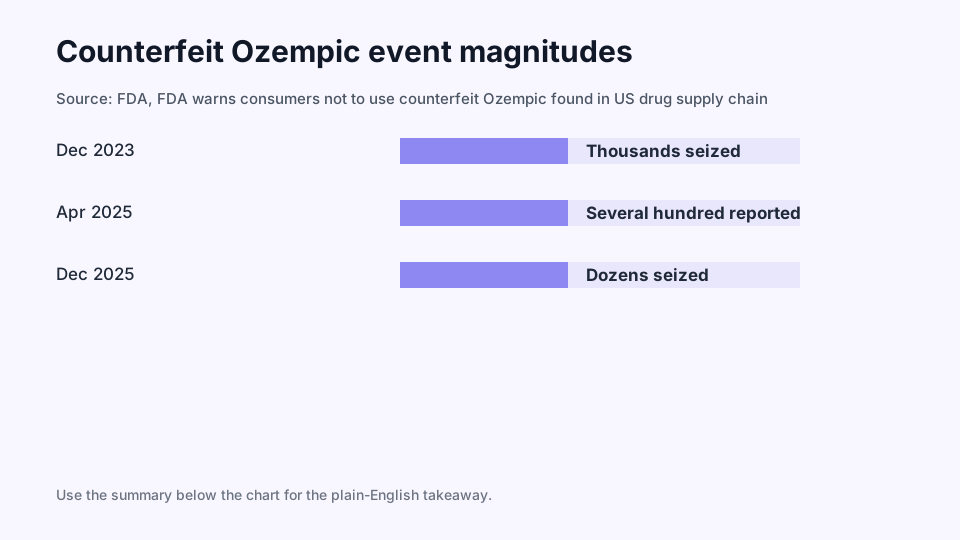
FDA reported broad magnitude labels for three identified events, so the visual compares their stated scale without inventing exact counts.
Counterfeit and compounded mean different things
A GLP-1, or glucagon-like peptide-1 receptor agonist, is a medicine class that includes semaglutide and tirzepatide. Ozempic and Wegovy contain semaglutide. Mounjaro and Zepbound contain tirzepatide. FDA-approved products have agency-reviewed labeling, manufacturing controls, and a traceable distribution system. A counterfeit product illegally claims to be an authentic approved medicine. It may contain the wrong ingredient, too much or too little active ingredient, no active ingredient, or an unwanted ingredient. A counterfeit can imitate a pen, carton, label, or needle well enough to look familiar. Compounded semaglutide or tirzepatide is different. A compounded drug may be made under limited legal conditions, but it is not FDA-approved as a finished product. FDA has also found fraudulent products falsely presented as compounded drugs, including labels naming pharmacies that did not make the product or do not exist. Those categories should not be treated as interchangeable.
| Product type | FDA status | Practical meaning |
|---|---|---|
| FDA-approved branded medicine | FDA-reviewed for labeled use, safety, effectiveness, and manufacturing quality. | Use a legitimate pharmacy and discuss questions with the pharmacist or prescriber. |
| Compounded semaglutide or tirzepatide | Not FDA-approved. | It has not undergone FDA premarket review as a finished product. |
| Fraudulent product presented as compounded | Not legitimate. | A label can falsely name a pharmacy or misstate what the product contains. |
| Counterfeit branded GLP-1 | Illegal and not authentic. | It falsely claims to be an approved branded medicine and can imitate its packaging. |
| Research-use peptide sold online | Not an FDA-approved prescription medicine. | A not-for-human-use label is not a safe route to treatment. |
Source: Source: FDA, FDA's Concerns with Unapproved GLP-1 Drugs Used for Weight Loss; FDA, Counterfeit Medicine.
What adverse-event reports can tell you
FDA said it had received 990 adverse-event reports related to compounded semaglutide and more than 730 related to compounded tirzepatide through May 31, 2026. These are not counterfeit-specific figures. They also do not prove that the compounded product caused every reported event. FDA notes that adverse events involving compounded GLP-1 products may be underreported because many state-licensed pharmacies are not required by federal law to submit reports to FDA. That means the totals are signals for safety monitoring, not a complete injury count. For the listed 2025 counterfeit Ozempic lots, FDA said reported adverse events were associated with authentic product rather than the counterfeits. That does not establish that a counterfeit pen is harmless. A small number of reports cannot settle the safety of an unknown product, especially when counterfeit needles and uncertain contents are involved.
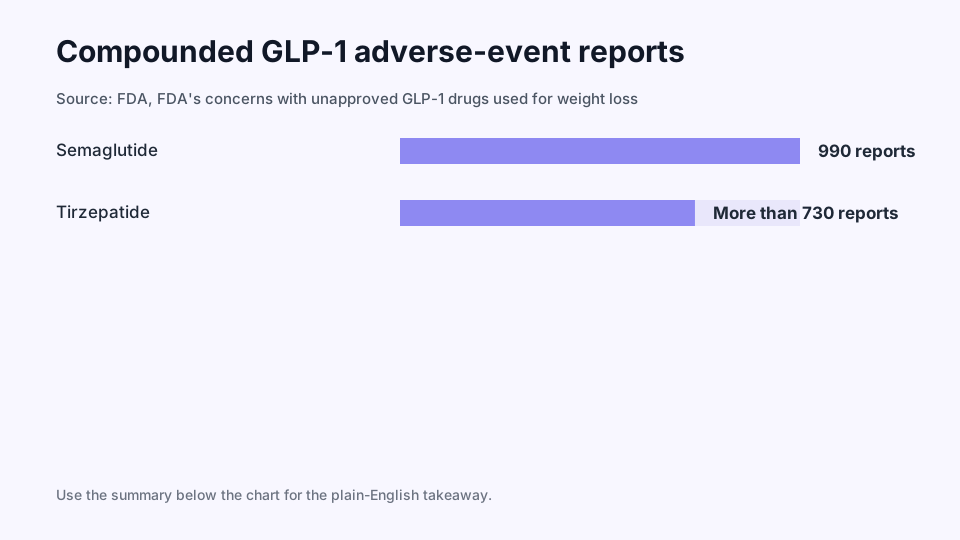
The totals are FDA adverse-event reports through May 31, 2026 for compounded products, not confirmed counterfeit harms or proof of causation.
Cost and coverage can create pressure
Cash prices and coverage rules can make people vulnerable to offers that sound like a workaround. Insurance coverage depends on the health plan, the medicine's approved use, prior authorization requirements, deductible, and pharmacy benefit rules. There is no national coverage percentage that can predict an individual plan's decision. A low price does not prove a product is fake. Manufacturer programs, insurance, and pharmacy arrangements can lower the price of legitimate treatment. Still, a dramatic discount paired with no prescription requirement, no clear pharmacy identity, no pharmacist, or overseas shipping is a reason to stop and verify the seller. Lilly lists Zepbound self-pay access starting at $299 per month for certain 2.5 mg presentations and ranging to $449 for other listed doses and refill conditions. That is a useful official comparison point, not a promise of your final cost. The listed price can change, and it does not answer whether an insurer will cover a particular prescription.
| Measure | Figure | How to interpret it |
|---|---|---|
| Counterfeit Ozempic seized | Thousands of units in December 2023 | A detected enforcement event, not a personal risk percentage. |
| Suspected counterfeit supply | Several hundred units in April 2025 | A specific identified event, followed by FDA seizure action. |
| Compounded semaglutide reports | 990 through May 31, 2026 | Reports are not confirmed causal injuries and are not counterfeit-specific. |
| Compounded tirzepatide reports | More than 730 through May 31, 2026 | The same reporting limitations apply. |
| Online pharmacy compliance | About 5% | A professional-looking website is not enough to establish legitimacy. |
| Official Zepbound self-pay access | $299 to $449 monthly | A current listed access range, not an insurance or final-price guarantee. |
Source: Source: FDA counterfeit Ozempic alert; FDA concerns with unapproved GLP-1 drugs; FDA BeSafeRx FAQ; Eli Lilly, Authentic Zepbound shipped through LillyDirect.
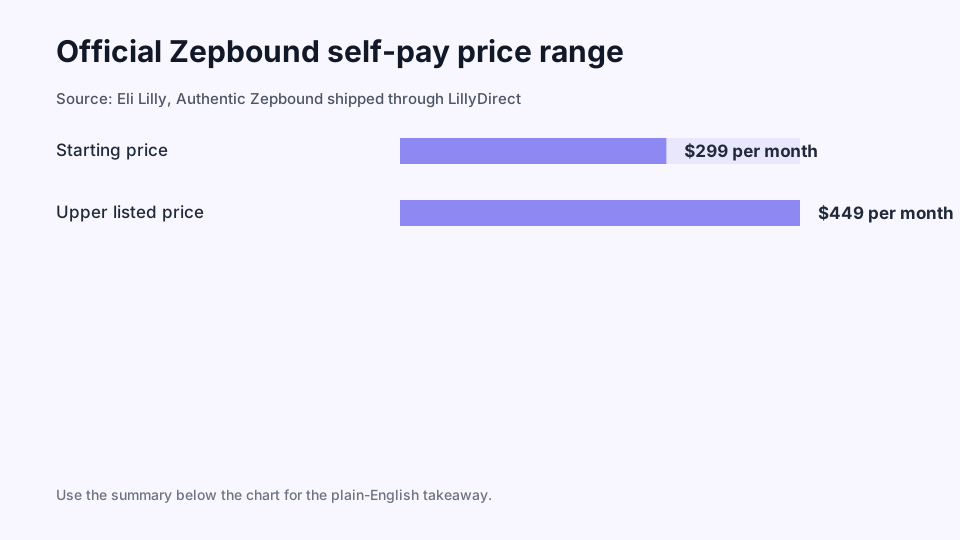
Lilly's listed self-pay range offers a legitimate access reference, while eligibility, dose, refill conditions, and final cost can vary.
How to check a source before using a shipment
Start with the prescription and pharmacy rather than trying to authenticate packaging at home. FDA says a safe online pharmacy requires a prescription, provides a US address and telephone number, has a licensed pharmacist, and is licensed by a state board of pharmacy. FDA's BeSafeRx material cites National Association of Boards of Pharmacy data estimating that about 5% of roughly 35,000 active online pharmacies comply with US pharmacy laws and practice standards. Keep the dispensing label, receipt, pharmacy name, and photos of the carton and pen when a shipment arrives. A pharmacy can compare the product with its records and manufacturer information. These details can also help an investigation if a problem is reported. If the packaging, device, label, needle, instructions, or usual experience seems different, do not rely on a social-media opinion. Contact the dispensing pharmacy and prescriber. For severe or concerning symptoms, seek urgent medical care. Suspected product problems, side effects, and medication errors can be reported through FDA MedWatch.
Why treatment interruptions need a plan
Counterfeit products cannot be ethically tested in clinical trials. No study can tell a person how much weight they would lose with a counterfeit pen, whether it contains an expected dose, or whether it is safe. Research on authentic treatment does show why a sudden interruption can matter. In the STEP 1 semaglutide extension, participants who received semaglutide 2.4 mg had lost an average of 17.3% of starting body weight by week 68. One year after treatment withdrawal, they had regained an average of 11.6 percentage points of body weight, about two-thirds of the weight they had lost. That study was an exploratory follow-up, so it cannot predict what will happen for every person. It does show why a coverage loss, supply concern, or unfamiliar product is worth a prompt conversation with the prescriber or pharmacist rather than an unplanned change to treatment.
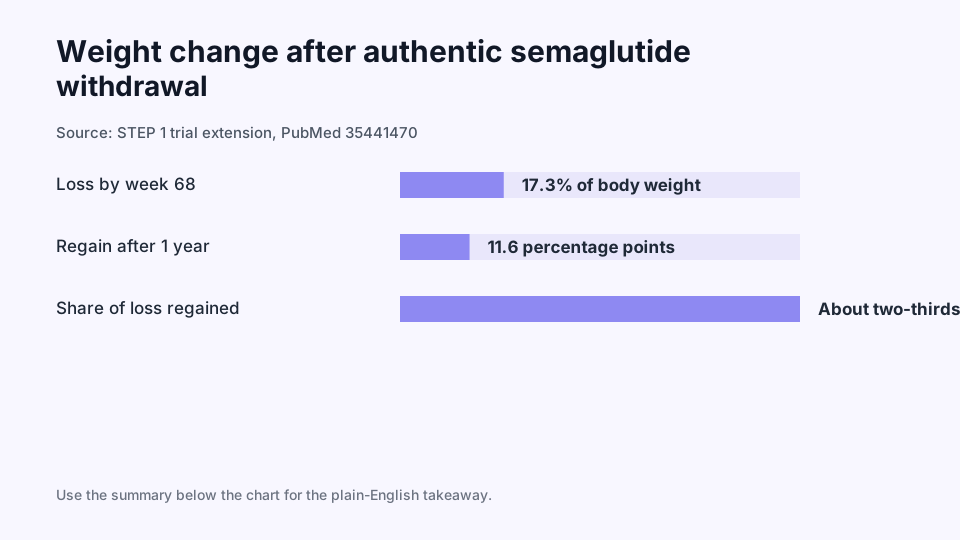
The STEP 1 extension shows why an interruption in authentic treatment deserves a planned discussion, but it does not predict an individual's result or describe counterfeit products.
Recent enforcement and import actions
On September 5, 2025, FDA announced a green list import alert for certain GLP-1 active pharmaceutical ingredient suppliers. The action was intended to stop potentially dangerous ingredients from unverified foreign sources entering the United States. It is an import control, not a tool for checking a pen at home. On June 9, 2026, the Department of Justice unsealed an indictment charging Swapnadip Roy and Vicky Ramancha with conspiracy, smuggling, and selling counterfeit drugs in an alleged counterfeit-Ozempic scheme. The government alleged counterfeit packaging, labeling, and needles, with products sourced from China and sold at deeply discounted prices. The case was pending when sources were checked, so these are allegations rather than convictions. No later FDA public alert identifying a new counterfeit Ozempic lot, patient-level counterfeit injury total, or nationwide prevalence estimate was found in the FDA and DOJ materials reviewed through August 30, 2026.
Questions to bring to a pharmacist or clinician
Ask whether the prescription is being filled by a pharmacy licensed in your state and whether the product is FDA-approved, compounded, or something else. If a compounded product is proposed, ask why it is being considered and what pharmacy will prepare and dispense it. Ask what to do if the carton, pen, vial, label, or instructions differ from a prior fill. If coverage changes or the next refill becomes unaffordable, ask about legitimate options before ordering from an unfamiliar seller. If treatment is interrupted, ask how to discuss a restart safely rather than making a dosing decision independently.
Methodology
- Source priority was FDA product alerts, FDA safety and regulatory materials, Department of Justice case records, official manufacturer access information, and peer-reviewed trial records.
- Sources were last checked on August 30, 2026. Broad terms such as thousands, several hundred, and dozens are reproduced because FDA did not publish exact unit counts for those events.
- Peptide sellers, social-media posts, affiliate pharmacies, generic approval trackers, marketing blogs, forums, and unverified counterfeit databases were excluded or treated cautiously. They cannot establish that a medicine is authentic or safe.
- Adverse-event reports are presented as reports, not confirmed injuries or proof of causation. Pending criminal charges are described as allegations.
- The guide is source-reviewed and not clinically reviewed. It cannot authenticate an individual pen, verify a pharmacy, determine coverage, recommend dosing, diagnose a condition, or decide whether a product is suitable for a person.
Update history
- Published with FDA, DOJ, manufacturer, and peer-reviewed sources checked through August 30, 2026.
Data notes
The downloadable dataset records the FDA's reported seizure magnitudes, compounded-product report totals, online-pharmacy compliance estimate, official access-price range, and STEP 1 withdrawal results. Magnitude labels remain qualitative where FDA did not provide exact unit counts.