Introduction
U.S. 2026 GLP-1 cash prices, Medicare Bridge access, trial weight-loss averages, safety limits, refill terms, and questions to ask.
2026 numbers at a glance
- $299 per 28 days - Lowest Zepbound self-pay price
- $449 per 28 days - Higher-dose Zepbound Journey price
- $699 per 28 days - Regular Zepbound 15 mg price
- $149 per month - Lowest Wegovy self-pay price
- $199 per month - Wegovy pen introductory price
- $349 per month - Standard Wegovy pen price
- $50 - Medicare Bridge copay
- 14.9% to 20.9% - Study-average weight loss
What a manufacturer cash price does and does cover
A manufacturer self-pay offer is not an insurance benefit and is not necessarily the medicine's list price. It may apply only through a named pharmacy route, a particular device, selected dose strengths, or a limited period. It may also exclude taxes, delivery, clinician appointments, laboratory work, and other service fees. Cash payment can be useful if a health plan excludes weight-management medicines or applies a high deductible. It can also leave you without credit toward your deductible or annual out-of-pocket maximum. NovoCare states that its self-pay prescriptions are processed outside insurance, so it is sensible to compare the cash route with any available prior authorization route before deciding. Four questions prevent many surprises: Is this a first-fill or continuing price? Does it apply at the strength I may use later? Is there a deadline for a refill? What charges sit outside the advertised medicine price?
| Medicine and route | Dose or situation | Listed price | Supply | What to check |
|---|---|---|---|---|
| Zepbound via LillyDirect or eligible major pharmacy | 2.5 mg | $299 | 28 days | Starting-dose price; the FDA label says 2.5 mg is for treatment initiation and is not a maintenance dose. |
| Zepbound via LillyDirect or eligible major pharmacy | 5 mg | $399 | 28 days | Confirm the route and current offer terms. |
| Zepbound Self Pay Journey Program | 7.5 mg to 15 mg | $449 | 28 days | Refill purchase must occur within 45 days of the prior delivery or receipt date. |
| Zepbound regular listed self-pay | 10 mg to 15 mg without Journey offer | $699 | 28 days | Shows the difference program terms can make. |
| Wegovy tablets through NovoCare or savings offer | 1.5 mg | $149 | 30 tablets | Dose-specific manufacturer offer. |
| Wegovy tablets through NovoCare or savings offer | 4 mg | $149 through August 31, then $199 | 30 tablets | Scheduled offer change, not a guaranteed future price. |
| Wegovy tablets through NovoCare or savings offer | 9 mg or 25 mg | $299 | 30 tablets | Higher tablet strengths have a higher listed price. |
| Wegovy pen new-patient offer | 0.25 mg or 0.5 mg | $199 | One month | First two monthly fills through December 31, 2026. |
| Wegovy pen standard self-pay offer | 0.25 mg to 2.4 mg | $349 | Four pens or one month | Listed ongoing amount after introductory pricing. |
| Wegovy HD pen | 7.2 mg | $399 | Four pens or one month | Separate product and pricing category. |
| Medicare GLP-1 Bridge | Eligible participating medicine | $50 copay | Covered fill | Eligibility and prior authorization still apply. |
Source: Sources: Eli Lilly Zepbound coverage and savings terms; NovoCare Wegovy savings offer and price guide; CMS Medicare GLP-1 Bridge. Prices were checked August 13, 2026 and may change.
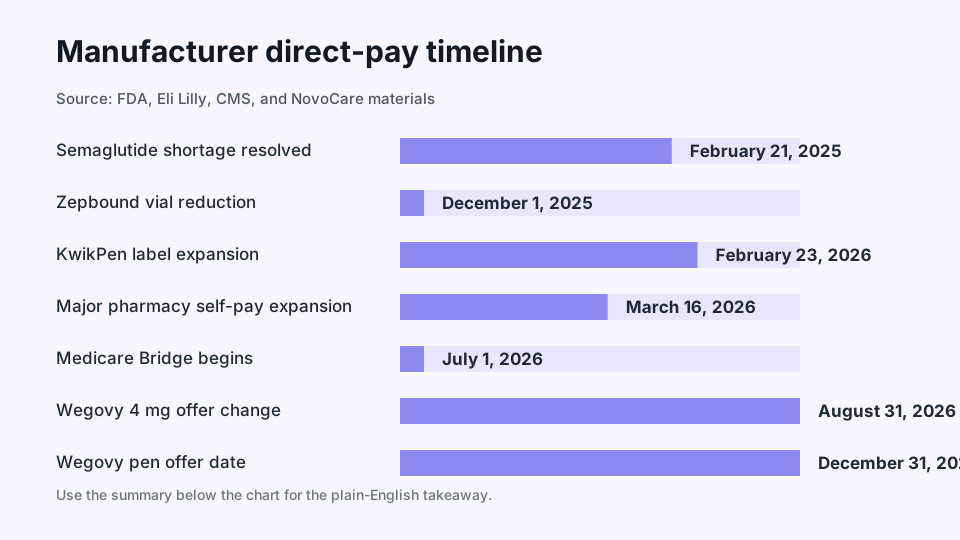
The timeline shows when supply policy, manufacturer routes, Medicare access, and scheduled Wegovy offer terms changed.
The access change affecting Medicare in 2026
The Medicare GLP-1 Bridge demonstration began July 1, 2026. CMS says eligible Medicare Part D beneficiaries can obtain participating GLP-1 medicines with a $50 copay through the demonstration. It runs through December 31, 2027. The Bridge is outside the usual Part D coverage and payment flow. The Part D deductible does not apply, and the $50 paid does not count toward True Out-of-Pocket spending, often shortened to TrOOP. Participation is not automatic: the diagnosis, medicine, eligibility rules, participating pathway, and prior authorization can still determine access. For people with employer insurance, Medicaid, or Marketplace coverage, there is no single national answer. A plan may cover one medicine but not another, apply prior authorization, or change formulary rules at renewal. Keep copies of coverage decisions and explanations of benefits alongside cash-price receipts.
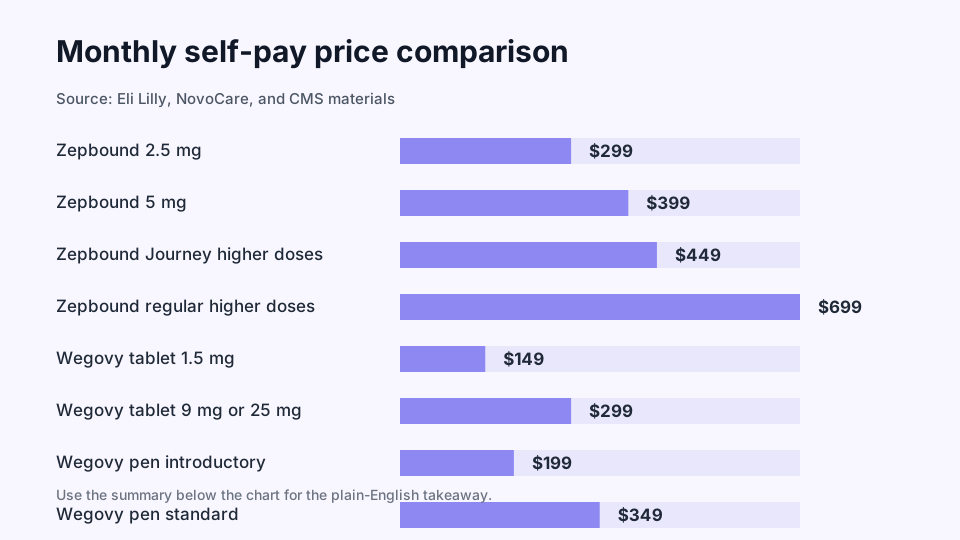
The price spread shows why a person should compare ongoing dose-specific program terms, not only the first advertised price.
What the trial results mean for expected weight loss
GLP-1 means glucagon-like peptide-1. Wegovy contains semaglutide, a GLP-1 receptor agonist. Zepbound contains tirzepatide, which acts at both the GLP-1 receptor and the glucose-dependent insulinotropic polypeptide, or GIP, receptor. In STEP 1, adults without diabetes who received semaglutide 2.4 mg had average weight loss of 14.9% at week 68. For a person starting at 250 pounds, that percentage is about 37 pounds. The placebo group averaged 2.4% loss. In SURMOUNT-1, adults without diabetes receiving tirzepatide averaged 15.0% loss at 5 mg, 19.5% at 10 mg, and 20.9% at 15 mg after 72 weeks. At 250 pounds, those group averages work out to roughly 38, 49, and 52 pounds. They are useful benchmarks, but the trials had different designs and do not provide a direct head-to-head forecast for one person. Results can differ because of starting weight, dose tolerance, other health conditions, adherence, food intake, activity, and whether someone can continue treatment. A clinician can put these group averages in context without promising a particular outcome.
| Trial and treatment | Timeframe | Average change from starting weight | What it may mean at 250 pounds |
|---|---|---|---|
| STEP 1 placebo | 68 weeks | -2.4% | About 6 pounds on average. |
| STEP 1 semaglutide 2.4 mg | 68 weeks | -14.9% | About 37 pounds on average. |
| SURMOUNT-1 placebo | 72 weeks | -3.1% | About 8 pounds on average. |
| SURMOUNT-1 tirzepatide 5 mg | 72 weeks | -15.0% | About 38 pounds on average. |
| SURMOUNT-1 tirzepatide 10 mg | 72 weeks | -19.5% | About 49 pounds on average. |
| SURMOUNT-1 tirzepatide 15 mg | 72 weeks | -20.9% | About 52 pounds on average. |
Source: Sources: STEP 1 and SURMOUNT-1 publications in the New England Journal of Medicine. Trials differ in design and duration; these figures are not head-to-head comparisons or individual forecasts.
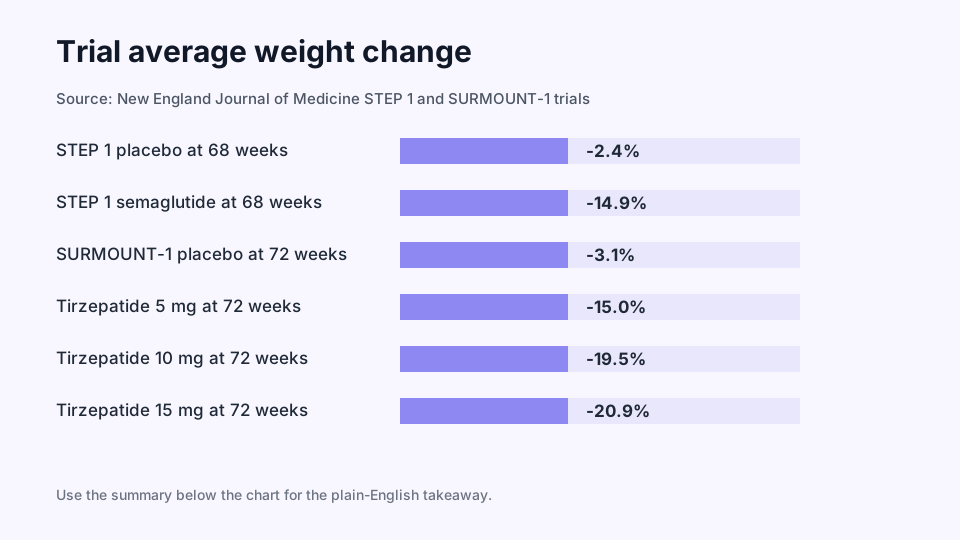
These separate trials show average group results over more than a year, not a direct head-to-head result or personal forecast.
Maintenance and stopping belong in the budget conversation
These medicines are commonly considered long-term treatment, which makes a short promotional price an incomplete budget. In the STEP 1 extension, participants regained a substantial amount of their prior weight loss during the year after stopping semaglutide. SURMOUNT-4 gives a more specific example. After a 36-week tirzepatide lead-in, participants switched to placebo regained 14.0% of body weight over the next 52 weeks. Those who continued tirzepatide lost a further 5.5% over that period. That evidence does not mean a person must stay on medicine indefinitely. It means that a possible coverage loss, cash-price change, or stop date deserves an advance conversation with the prescriber. Ask what follow-up will be needed if access changes, rather than waiting until the last fill.
| Date | Event | Practical effect |
|---|---|---|
| February 21, 2025 | FDA said the semaglutide injection shortage was resolved. | Routine compounding based on a nationwide shortage became harder to justify under federal rules. |
| December 1, 2025 | Lilly announced lower Zepbound single-dose vial prices. | The 2.5 mg vial price moved to $299; qualifying higher-dose refills moved to $449. |
| February 23, 2026 | Lilly announced an FDA-approved Zepbound KwikPen label expansion. | A four-dose, single-patient-use pen became an option alongside vials. |
| March 16, 2026 | Lilly said KwikPen self-pay pricing would reach major pharmacies. | Eligible people may have local pickup rather than home delivery. |
| July 1, 2026 | CMS launched Medicare GLP-1 Bridge. | Eligible Part D beneficiaries can use participating medicines with a $50 copay. |
| August 31, 2026 | Scheduled Wegovy 4 mg tablet offer change. | Novo Nordisk says the $149 offer moves to $199 after this date. |
| December 31, 2026 | Scheduled end of certain Wegovy pen introductory prices. | The stated $199 new-patient price applies to two monthly fills through this date. |
Source: Sources: FDA, Eli Lilly, CMS, and NovoCare materials. Scheduled offer dates are subject to manufacturer terms and are not guaranteed future pricing.
Safety and product checks before choosing a lower price
Lower cost should not mean lower standards for product verification. FDA-approved Wegovy and Zepbound have boxed warnings about thyroid C-cell tumors observed in rats. Their labels contraindicate use for people with a personal or family history of medullary thyroid carcinoma or Multiple Endocrine Neoplasia syndrome type 2. The labels also warn about serious gastrointestinal effects, gallbladder disease, pancreatitis, kidney injury related to dehydration, low blood sugar in some people using other glucose-lowering medicines, and other risks. Common side effects can include nausea, diarrhea, vomiting, constipation, abdominal pain, indigestion, fatigue, and injection-site reactions. A clinician or pharmacist can explain when symptoms need prompt attention. FDA has raised concerns about unapproved GLP-1 products sold for weight loss, including false labels, dosing errors, and semaglutide salt forms that are not the same as the active ingredient in FDA-approved medicines. The agency has determined that nationwide shortages of semaglutide and tirzepatide injections were resolved. Do not assume a compounded product is an equivalent substitute because the advertised price is lower. Before paying, identify the prescriber, dispensing pharmacy, exact product name, manufacturer, dose form, total price, refill terms, and whether the product is FDA-approved or compounded. If any of those are unclear, pause and ask the pharmacy or prescriber.
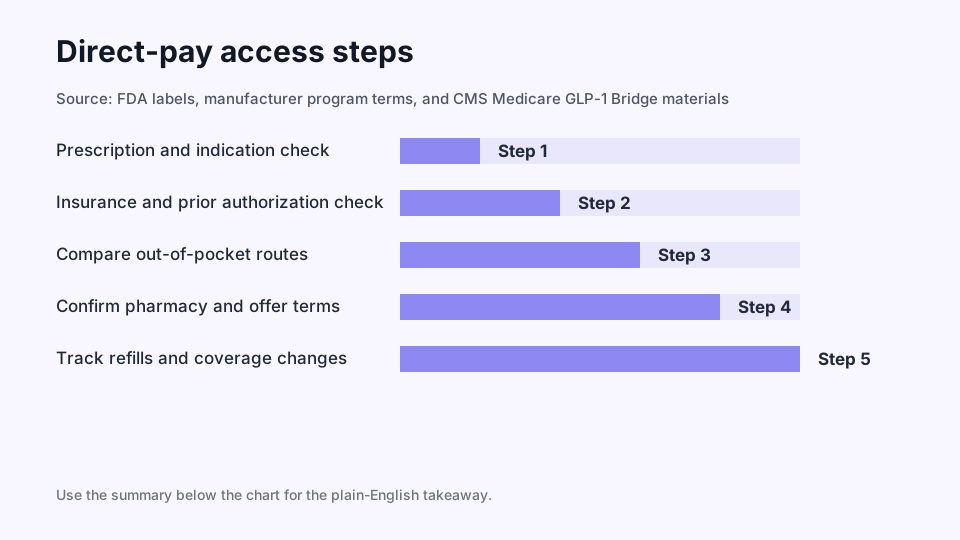
The five steps help a person verify legitimacy, compare payment routes, and avoid missing a price condition or refill deadline.
A practical record for appointments and refill decisions
Make a short record before starting, restarting, or moving from insurance to cash pay. Write down the medicine name, strength, first-fill date, refill date, pharmacy, total paid, manufacturer offer, and offer end date. For the Lilly higher-dose Journey offer, include the 45-day refill window. Track side effects, food tolerance, hydration, weight trend, missed work, and any coverage changes. If you have diabetes, ask how glucose changes and A1c, also called HbA1c, fit into the plan. A1c is a blood test that estimates average blood sugar over roughly three months. Bring direct questions: Is this FDA-approved for my reason for use? What will the likely cost be after the first two or three fills? Is prior authorization available? Which symptoms should lead me to contact the prescriber, pharmacist, or urgent care? If cost forces a stop, what follow-up plan makes sense?
Methodology
- Source priority was FDA labels and safety notices for approval, indications, warnings, and supply status; CMS for Medicare rules; official manufacturer pages for cash offers; and peer-reviewed trials for outcomes.
- All pricing, access, and source materials were checked August 13, 2026. Manufacturer offers, pharmacy availability, and payer rules can change after that date.
- Affiliate price roundups, telehealth marketing pages, pharmacy blogs, social posts, peptide sellers, unverified compounded-drug vendors, generic approval trackers, and anecdotal stories were excluded or treated cautiously.
- The figures cannot determine individual eligibility, final local charges, insurance approval, safest treatment choice, appropriate dose, or personal weight loss. The guide is source-reviewed and not clinically reviewed.
- Trial participants had structured follow-up and defined eligibility criteria, so study averages may not match routine care.
Update history
- Published with manufacturer self-pay offers, CMS Medicare GLP-1 Bridge details, FDA materials, and trial evidence checked on this date.
Data download
Download the source-backed price, access, trial, and timeline values used in the tables and figures. Program prices are snapshots of manufacturer terms checked August 13, 2026.