Introduction
US GLP-1 cost statistics for 2026, including Wegovy and Zepbound cash offers, insurance copays, Medicare access, maintenance, and safety.
Eight facts to know before comparing prices
- $1,349.02 per package - Wegovy injection list price
- $349 per 28 days - Wegovy standard self-pay offer
- $299 per 28 days - Zepbound KwikPen entry price
- $1,086.37 - Zepbound package WAC
- 24% - Reported full insurance payment
- 54% - Reported affordability difficulty
- $50 per month - Medicare Bridge payment
- 11.6 percentage points - STEP 1 withdrawal regain
How to read a GLP-1 price quote
List price, also called wholesale acquisition cost or WAC, is the manufacturer's price to wholesalers before rebates. It can affect deductible and coinsurance calculations, but it is not necessarily the amount a cash customer pays. A pharmacy cash quote may be higher or lower, and an insurance claim may use a negotiated amount that is never shown to the patient. A manufacturer self-pay offer is a separate route. It may require an eligible prescription, a named pharmacy pathway, a particular device, a refill interval, or commercial insurance status. Cash-program payments generally do not count toward an insurance deductible or annual out-of-pocket maximum, so compare the immediate price with the value of using insurance later in the year.
| Medicine or route | Approved use relevant here | List price or WAC | Advertised cash or self-pay offer | What to check |
|---|---|---|---|---|
| Wegovy injection | Chronic weight management and selected labeled cardiovascular-risk reduction | $1,349.02 per package | $349 per 28 days; $199 for first two eligible starter fills | Starter offer ends after two fills and terms apply |
| Wegovy HD injection | Chronic weight management | $1,349.02 per package | $399 per 28 days | Confirm device and strength eligibility |
| Zepbound KwikPen | Chronic weight management and obstructive sleep apnea in eligible adults with obesity | $1,086.37 four-pen package WAC | $299 at 2.5 mg; $399 at 5 mg; eligible higher-dose purchase offer can be $449 | Higher-dose offer has refill-timing terms |
| Ozempic pen | Type 2 diabetes and selected labeled cardiovascular and kidney-risk indications | $1,027.51 per listed pen package | $199 for two eligible introductory fills, then generally $349 for 0.25 to 1 mg or $499 for 2 mg | The diabetes indication and offer terms matter |
| Mounjaro | Type 2 diabetes | Not independently verified here from a current displayable WAC | Eligible commercially insured people without coverage may pay as low as $499 | Check Lilly program eligibility and plan coverage |
Source: Sources: NovoCare Wegovy injection self-pay offer terms and prices; NovoCare Ozempic savings and self-pay information; Eli Lilly Zepbound savings and insurance options; Eli Lilly Zepbound cost and list-price information; Eli Lilly Mounjaro savings and coverage information.
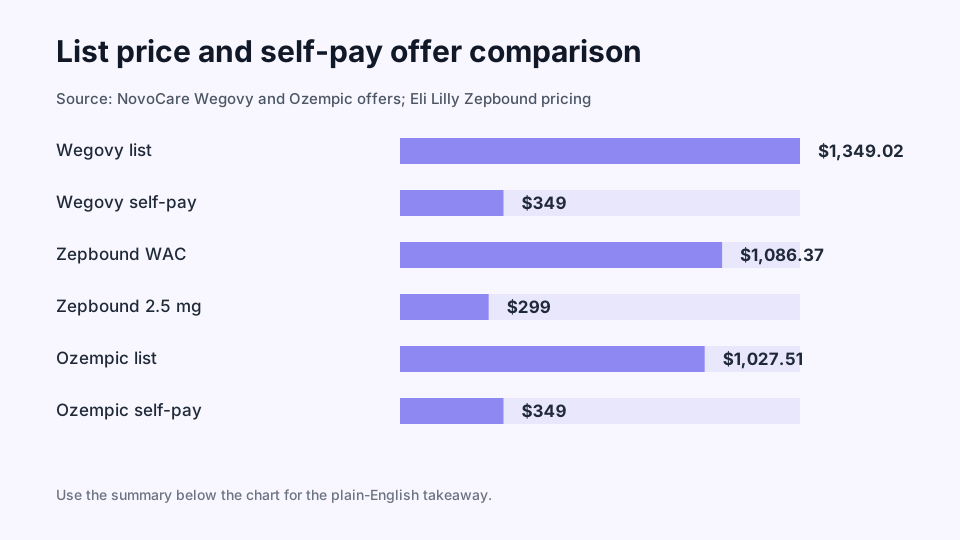
List prices exceed $1,000, while conditional manufacturer self-pay offers shown here range from $299 to $349 for the selected products and doses.
Why insurance coverage can change the answer
Coverage is often easier to obtain for a medicine prescribed for type 2 diabetes than for a weight-management medicine, but each plan sets its own formulary and approval rules. Prior authorization means the insurer asks for advance documentation before it will pay. Step therapy means it may require a person to try another treatment first. KFF found that 57% of insured past or current GLP-1 users said insurance paid part of the cost and they paid the rest. Another 24% said insurance paid the full cost, while 19% said they paid the full cost themselves. That range explains why an advertised $25 amount should not be treated as a typical insurance copay. A Peterson-KFF analysis found people with large-employer coverage paid nearly $70 monthly on average for covered semaglutide. It is useful context, not a forecast. A deductible reset, coinsurance percentage, non-covered diagnosis, or denied authorization can produce a much larger amount.
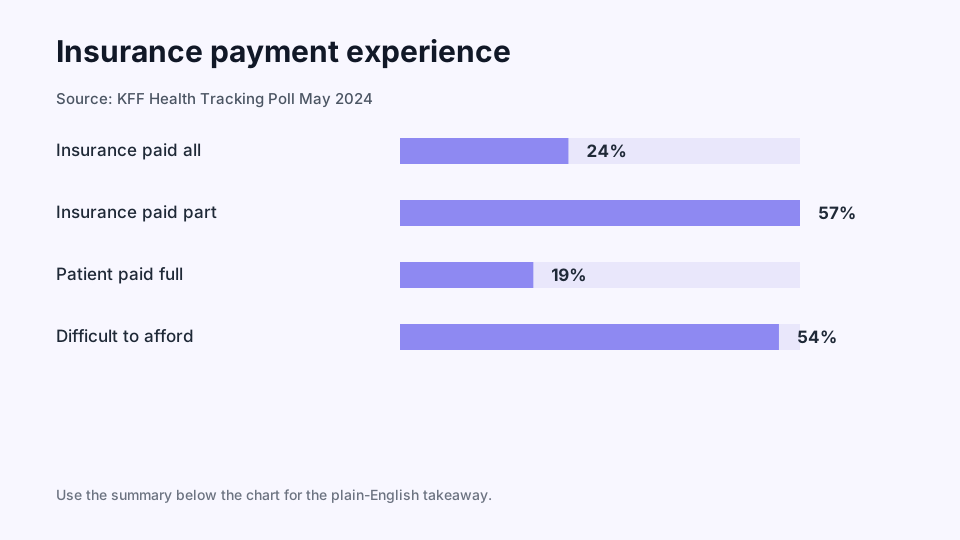
Most insured users reported paying some part of the cost, and affordability difficulty remained common among people who had used GLP-1 medicines.
| Route | What the stated amount means | Limits to know | Useful question |
|---|---|---|---|
| Commercial insurance with a savings card | Some eligible offers advertise as little as $25 monthly | Savings caps, diagnosis rules, and government-insurance exclusions apply | Is the quoted amount my plan copay or a manufacturer discount? |
| Insurance during a deductible | The patient may pay a larger share until the deductible is met | January resets can change the amount due | What will I owe before and after my deductible? |
| Medicare GLP-1 Bridge | Eligible Part D beneficiaries pay $50 monthly | Available through December 31, 2027 and outside ordinary Part D payment flow | Do I meet Bridge eligibility or should my plan process the prescription under standard Part D? |
| Manufacturer self-pay route | A cash offer can be lower than an insurance claim | Usually does not apply to deductible or out-of-pocket maximum | Will the cash payment count toward my plan spending limit? |
| Standard Part D coverage | Some labeled uses may be evaluated through usual Part D rules | Coverage is indication-specific and plan-specific | Is my prescribed use covered under my plan's formulary? |
Source: Sources: Centers for Medicare & Medicaid Services Medicare GLP-1 Bridge information for Part D plans; Centers for Medicare & Medicaid Services Bridge launch announcement; NovoCare savings and support information; KFF Health Tracking Poll.
Medicare access has a limited new route
On July 1, 2026, the Centers for Medicare & Medicaid Services launched the Medicare GLP-1 Bridge nationwide. Eligible Medicare Part D beneficiaries can receive specified weight-management products for a $50 monthly copay through December 31, 2027. The program currently includes Wegovy injection and tablets, Foundayo, and Zepbound KwikPen, rather than Zepbound single-dose pens or vials. The Bridge payment is outside the usual Part D payment and coverage flow. It does not count toward the Part D deductible or annual true out-of-pocket limit. People using Wegovy for an already coverable cardiovascular indication, or Zepbound for obstructive sleep apnea, may instead need their plan to assess coverage through the normal Part D process.
Higher doses can change Zepbound self-pay costs
Lilly's Zepbound KwikPen pricing is dose-specific. The listed regular 28-day self-pay prices are $299 for 2.5 mg, $399 for 5 mg, $499 for 7.5 mg, and $699 for 10 mg, 12.5 mg, or 15 mg. An eligible purchase offer can bring 7.5 mg and higher to $449, but the refill must be completed within 45 days to continue that offer. That condition has a real budgeting effect. A delayed refill or prescription change can affect the next price. Before a dose change, ask the pharmacy for the exact cash total and ask whether the current program conditions still apply.
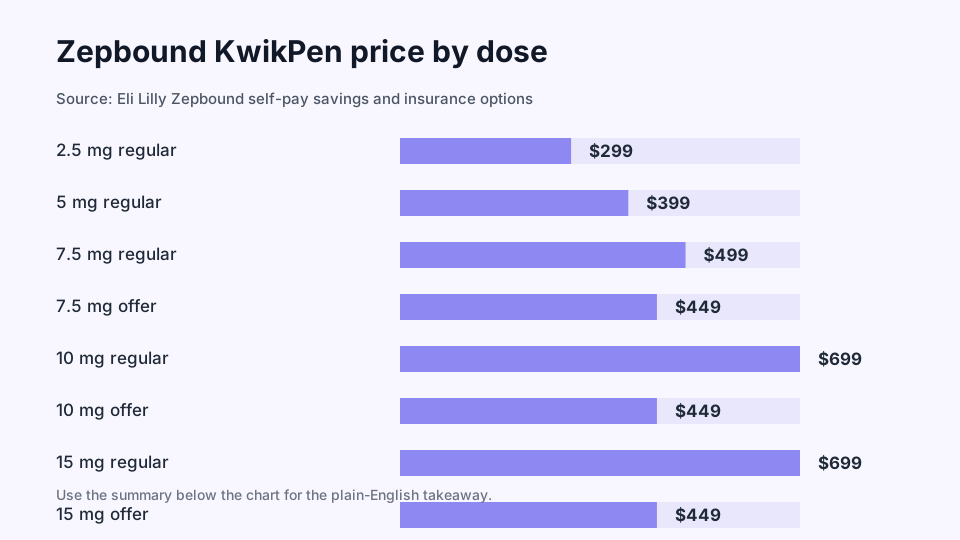
Regular listed self-pay prices increase by dose, while an eligible $449 purchase offer may lower higher-dose costs if its refill-timing terms are met.
Long-term treatment changes the affordability calculation
Wegovy and Zepbound are approved to reduce excess body weight and help maintain weight reduction over the long term. For that reason, the initial cash offer is only part of the financial decision. A sustainable plan may include the later dose price, clinician visits, laboratory work when ordered, nutrition support, and the possibility of insurance changes. In the 68-week STEP 1 trial, semaglutide 2.4 mg produced substantial average weight loss. In the extension, participants who stopped semaglutide regained an average 11.6 percentage points of body weight during the next year after losing 17.3% while on treatment. Put plainly, the group regained about two-thirds of the weight it had lost. In SURMOUNT-1, average weight change at 72 weeks with tirzepatide was 15.0% at 5 mg, 19.5% at 10 mg, and 20.9% at 15 mg, compared with 3.1% with placebo. At a starting weight of 250 pounds, 15% is about 38 pounds and 20.9% is about 52 pounds. These are study averages under trial conditions, not a promise of a particular result. SURMOUNT-5 found average 72-week weight change of 20.2% with tirzepatide and 13.7% with semaglutide in its study population. The difference does not decide the right medicine for one person. Tolerability, approved use, health history, coverage, and the cost a household can sustain can matter as much as a trial average.
| Study and medicine | Timeframe | Average group result | What it means for cost planning |
|---|---|---|---|
| STEP 1 extension, semaglutide withdrawal | One year after stopping | 11.6 percentage points of body-weight regain after 17.3% loss during treatment | Stopping may bring regain, so plan before a program price or coverage period ends |
| SURMOUNT-1, tirzepatide 5 mg | 72 weeks | 15.0% average weight change | At 250 pounds, that is about 38 pounds on average under trial conditions |
| SURMOUNT-1, tirzepatide 10 mg | 72 weeks | 19.5% average weight change | At 250 pounds, that is about 49 pounds on average under trial conditions |
| SURMOUNT-1, tirzepatide 15 mg | 72 weeks | 20.9% average weight change | At 250 pounds, that is about 52 pounds on average under trial conditions |
| SURMOUNT-5, tirzepatide versus semaglutide | 72 weeks | 20.2% versus 13.7% average weight change | The comparison informs expectations, but it does not replace an individual coverage and safety discussion |
Source: Sources: PubMed Central STEP 1 extension; New England Journal of Medicine SURMOUNT-1; New England Journal of Medicine SURMOUNT-5.
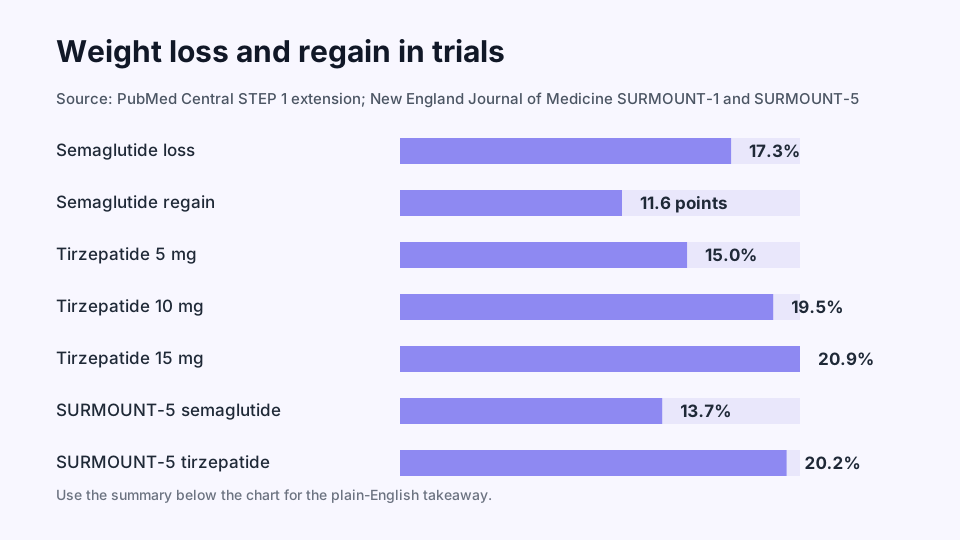
The trial results show substantial average loss during treatment and meaningful regain after semaglutide withdrawal, which makes long-term affordability part of treatment planning.
Safety and lower-cost alternatives need careful discussion
Common side effects in trials include nausea, diarrhea, constipation, vomiting, and abdominal discomfort. FDA labels also carry a boxed warning about thyroid C-cell tumors observed in rodents. Wegovy and Zepbound are contraindicated for people with a personal or family history of medullary thyroid carcinoma or multiple endocrine neoplasia syndrome type 2. A low advertised price for compounded semaglutide or tirzepatide does not establish that a product is equivalent to an FDA-approved medicine. The FDA says compounded products are not FDA-approved versions of Wegovy, Ozempic, Zepbound, or Mounjaro and has reported concerns including dosing errors, adverse-event reports, and semaglutide salt forms that differ from the approved active ingredient. A pharmacist or prescriber can help assess a specific product and its source.
A practical call list before starting or refilling
Ask the insurer whether the medicine is on the formulary for the diagnosis written on the prescription. Ask whether prior authorization, step therapy, or a quantity-limit exception applies. Then ask for the price before and after the deductible, and whether the charge is a flat copay or coinsurance, meaning a percentage of the allowed price. Ask the pharmacist to run the prescription through insurance before deciding whether a self-pay offer is cheaper. Confirm the exact device, dose, pharmacy, fill length, and refill deadline. Keep authorization letters and note their expiration dates, because a previous approval may not renew automatically. Lina is a GLP-1 companion app for people using Wegovy, Mounjaro, Ozempic, Zepbound, Saxenda, and related medications. It helps users track doses, side effects, meals, weight, protein, hydration, and habits in one place. It is a wellness tracking companion, not a medical device or a substitute for medical advice.
Methodology
- Source priority was FDA prescribing information and safety communications, CMS program guidance, official manufacturer pricing and savings pages, peer-reviewed trials, and KFF research for affordability context.
- Prices and access rules were last checked on August 9, 2026. Offers, formularies, inventory, and eligibility can change during the year.
- Affiliate pages, coupon aggregators, pharmacy marketing blogs, social posts, peptide sellers, speculative approval trackers, and unverified compounded-product advertising were excluded or treated cautiously.
- List prices are shown only where a manufacturer disclosure supplied a specific figure. Cash figures are labeled as conditional offers, not universal retail prices.
- The figures cannot calculate an individual copay, establish savings-card eligibility, verify inventory, recommend a dose, or determine whether starting, stopping, restarting, or switching is medically appropriate.
Update history
- Updated source review.
- Updated source review.
Data download
The downloadable dataset contains the displayed price offers, coverage statistics, program dates, and trial percentages with source labels. Values are point-in-time figures and should be rechecked before use.