Introduction
FDA national shortages for semaglutide and tirzepatide are resolved. See 2026 US access, compounding, price, Medicare, safety, and maintenance facts.
Eight facts to know
- December 19, 2024 - Tirzepatide shortage resolved
- February 21, 2025 - Semaglutide shortage resolved
- 2022 - Semaglutide shortage began
- 605 - Compounded semaglutide reports
- 545 - Compounded tirzepatide reports
- July 1, 2026 - Medicare Bridge launch
- $50 monthly - Medicare Bridge copay
- 13 states - Medicaid obesity coverage
What resolved shortages mean at the pharmacy
FDA's shortage finding measures national supply, not the inventory in one pharmacy near you. FDA says intermittent local disruptions can continue while products move through manufacturers, distributors, and pharmacies. A pharmacy message saying out of stock does not by itself show that the medicine has returned to a national shortage. When a refill is blocked, ask what is actually blocking it. Is the issue the product, a specific strength, a wholesaler delay, an insurance rejection, or a prior authorization? The answer can save time because those problems have different routes for resolution.
| Date | Event | What it means |
|---|---|---|
| 2022 | Semaglutide injections entered shortage | Approved products became hard to obtain for many people. |
| December 19, 2024 | FDA resolved tirzepatide injection shortage | Routine compounded copies faced tighter federal limits. |
| February 21, 2025 | FDA resolved semaglutide injection shortage | National supply was judged able to meet demand. |
| April 22, 2025 | Many 503A semaglutide enforcement periods ended | A former shortage alone no longer supported routine copies. |
| May 22, 2025 | 503B semaglutide enforcement period ended | Outsourcing facilities also faced restored limits. |
| July 1, 2026 | Medicare GLP-1 Bridge launched | Some eligible Part D members gained a $50 monthly route. |
Source: Source: U.S. Food and Drug Administration, FDA clarifies policies for compounders as national GLP-1 supply begins to stabilize; Centers for Medicare & Medicaid Services, Medicare GLP-1 Bridge.
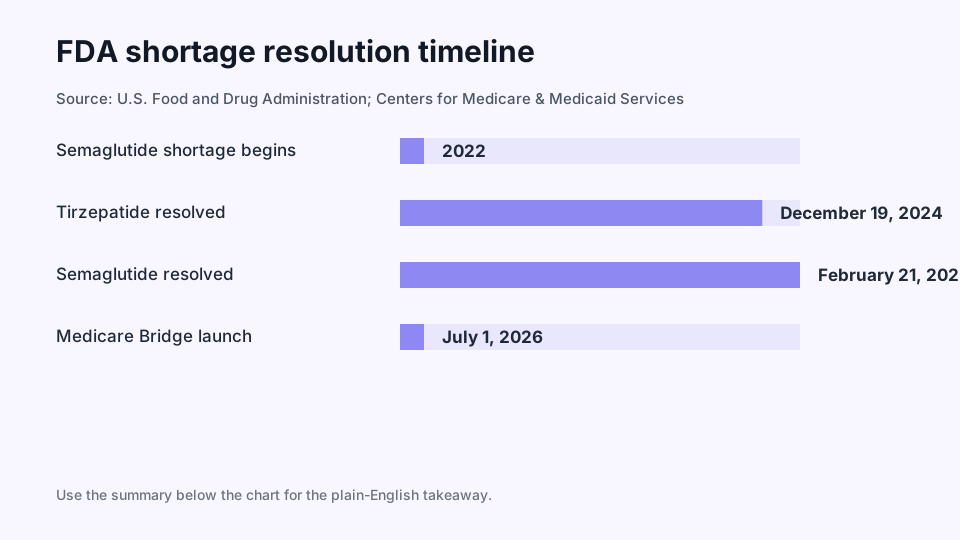
The timeline separates the end of national shortages from the later Medicare access program.
Compounding after the shortage
A compounded GLP-1 product is not the same as an FDA-approved product. FDA does not pre-review compounded medicines for safety, effectiveness, or manufacturing quality. Federal compounding pathways can apply in defined circumstances, but FDA says compounders generally cannot regularly make products that are essentially copies of commercially available approved drugs. Being cheaper, sold in a vial, or shipped to a home does not on its own establish a medical need for a compounded copy. FDA says compounded drugs should generally be used when a patient's medical need cannot be met by an FDA-approved drug. Individual circumstances and state pharmacy rules can matter, so this is a useful discussion for a prescriber and pharmacist rather than a decision to make from advertising alone.
FDA has described reports of dosing errors, doses beyond approved labeling, warm deliveries, inadequate cold packs, fraudulent labels, and use of semaglutide salt forms such as semaglutide sodium or semaglutide acetate. FDA says it does not know of a lawful basis for using those salt forms in compounding. Products labeled for research use or not for human consumption should not be used as medicines. Through July 31, 2025, FDA had received 605 adverse-event reports associated with compounded semaglutide and 545 associated with compounded tirzepatide. Those reports are incomplete and cannot prove that the compounded product caused each event. They do show why concentration, dose measurement, shipping, and pharmacy identity matter.
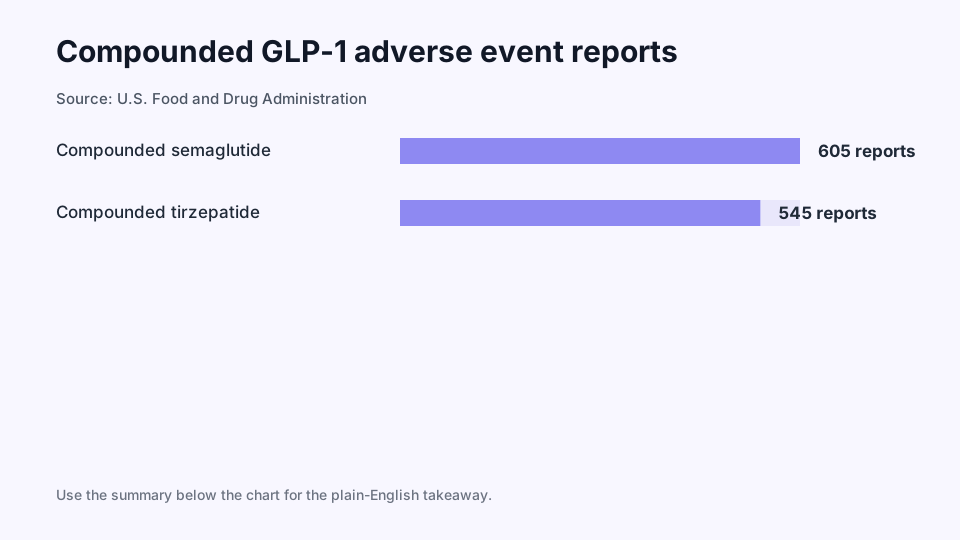
FDA report totals through July 31, 2025 are signals for caution, not proof that a compounded drug caused each event.
Cost and coverage in 2026
A listed cash price, insurance copay, and public-program benefit are different numbers. Lilly lists regular self-pay KwikPen prices for Zepbound from $299 to $699 per 28-day month, depending on strength. Taxes, fees, eligibility rules, and offer terms can change, so confirm the current terms before filling. Coverage remains uneven. KFF counted 13 state Medicaid fee-for-service programs covering GLP-1 medicines for obesity in January 2026. Even where coverage exists, prior authorization and other utilization rules are common. Employer plans and Medicaid managed-care plans may use different rules from a state fee-for-service policy.
| Measure | Figure | Practical meaning |
|---|---|---|
| Medicare GLP-1 Bridge | $50 per month | Defined copay for eligible participants, not universal Medicare coverage. |
| Zepbound KwikPen 2.5 mg | $299 per 28 days | Official regular self-pay price before possible taxes and fees. |
| Zepbound KwikPen 5 mg | $399 per 28 days | Self-pay price, not an insurance copay. |
| Zepbound KwikPen 7.5 mg | $499 per 28 days | Self-pay price subject to program terms. |
| Zepbound KwikPen 10 mg, 12.5 mg, 15 mg | $699 per 28 days | Listed price does not compare clinical benefit by strength. |
| Medicaid obesity coverage | 13 states in January 2026 | Coverage remains limited and policy can change. |
Source: Source: Eli Lilly, Zepbound Savings and Insurance Options; KFF, Medicaid Coverage of and Spending on GLP-1s; Centers for Medicare & Medicaid Services, Medicare GLP-1 Bridge.
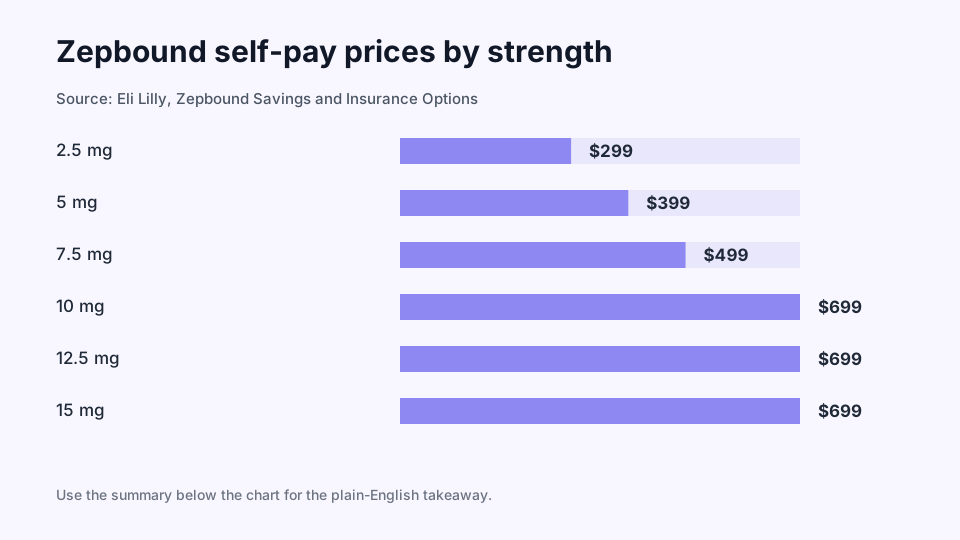
Listed regular self-pay prices for a 28-day KwikPen supply rise by strength, before possible taxes and fees.
The Medicare GLP-1 Bridge started July 1, 2026 and is scheduled to end December 31, 2027. CMS says eligible Medicare Part D members can receive certain GLP-1 medicines for weight management at a $50 monthly copay outside the usual Part D payment flow. It requires a qualifying prescription and prior authorization. It is not a general obesity-drug benefit for every person with Medicare. CMS says people already eligible for GLP-1 treatment through standard Part D coverage for type 2 diabetes, moderate-to-severe obstructive sleep apnea, or certain liver disease cannot use the Bridge simply because their plan does not list the medicine for another reason. Ask the plan or pharmacist whether the prescription should go through regular Part D or the Bridge.
What trials say about staying on treatment
Supply and payment interruptions matter because GLP-1 treatment often has a maintenance component. In STEP 1, adults with overweight or obesity taking once-weekly semaglutide 2.4 mg with lifestyle intervention lost an average 14.9% of starting weight at 68 weeks, compared with 2.4% with placebo. For someone starting at 220 pounds, 14.9% is about 33 pounds on average, not a guaranteed result. SURMOUNT-4 tested what happened after people had already used tirzepatide for 36 weeks. They lost an average 20.9% during that lead-in. Over the next 52 weeks, people who continued tirzepatide lost another 5.5% on average, while those switched to placebo regained 14.0% from the point of switching.
| Trial measure | Result | What it can mean |
|---|---|---|
| STEP 1 semaglutide at 68 weeks | 14.9% average weight loss | About 33 pounds in a 220-pound starting-weight example. |
| STEP 1 placebo at 68 weeks | 2.4% average weight loss | Lifestyle support produced less average loss in this trial. |
| SURMOUNT-4 lead-in at 36 weeks | 20.9% average weight loss | Participants entered the withdrawal comparison after substantial loss. |
| SURMOUNT-4 continuing tirzepatide | 5.5% further loss over 52 weeks | Continuing treatment maintained and increased the earlier average loss. |
| SURMOUNT-4 switching to placebo | 14.0% regain over 52 weeks | Regain was common after stopping in this trial. |
| Maintained at least 80% of initial loss | 89.5% continuing vs 16.6% placebo | Continuation was much more likely to preserve most prior loss. |
Source: Source: New England Journal of Medicine, Once-Weekly Semaglutide in Adults with Overweight or Obesity; JAMA, SURMOUNT-4 tirzepatide maintenance and withdrawal trial.
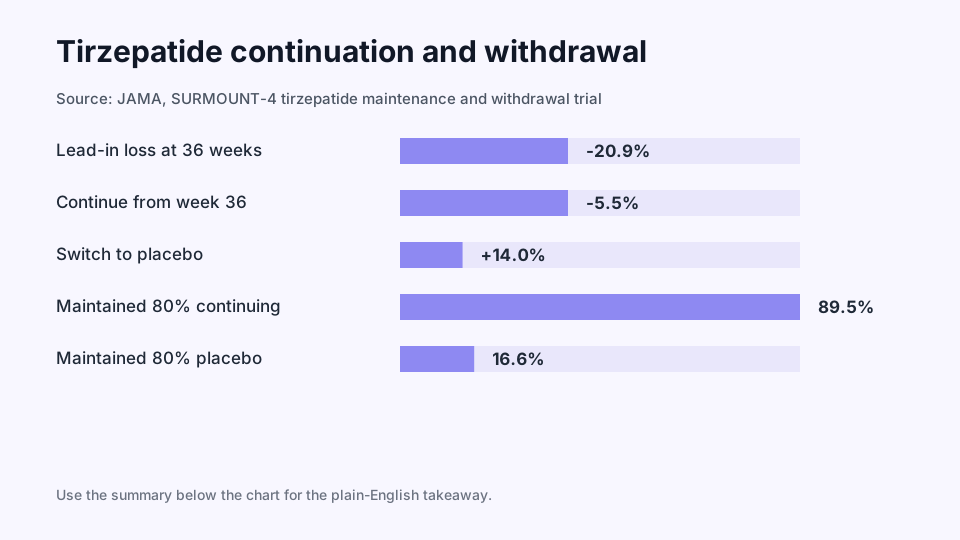
After initial loss, participants who continued tirzepatide had a very different average maintenance result from those switched to placebo.
The trial does not mean everyone must remain on a GLP-1 medicine indefinitely. It does mean that stopping due to cost, access, side effects, or preference deserves a plan. A clinician can help weigh maintenance goals, monitoring, food routines, activity, and what to do if a refill interruption occurs. Approved products also have important safety warnings. The Zepbound label includes severe gastrointestinal reactions, dehydration-related kidney injury, gallbladder disease, pancreatitis, serious allergic reactions, and a boxed warning about thyroid C-cell tumors seen in rats. It says Zepbound should not be used by people with a personal or family history of medullary thyroid carcinoma or Multiple Endocrine Neoplasia syndrome type 2. Labels are not individual treatment instructions.
A practical refill and coverage routine
Keep a short record of the exact medicine name, product form, strength, fill date, pharmacy, insurance decision, out-of-pocket amount, side effects, and refill date. That record is useful when a pharmacy changes, a prior authorization is submitted, a savings offer is checked, or a clinician needs to understand what happened. If a refill fails, contact the pharmacy first and ask whether the problem is stock, a particular strength, wholesaler supply, an insurance rejection, or authorization. Then call the plan number on the insurance card for the exact drug and ask about diagnosis criteria, quantity limits, prior authorization, and appeals. Do not change products, strength, or dose without direction from the prescriber.
Questions for a clinician or pharmacist
- Is my prescription for an FDA-approved product and an approved use?
- Is the barrier supply, coverage, prior authorization, or price?
- Can the pharmacy identify whether another location has the prescribed product?
- If I have Medicare, could I qualify for the Medicare GLP-1 Bridge?
- If I am considering a compounded product, what medical need cannot be met by the FDA-approved option?
- Which symptoms need a call to the prescriber, urgent care, or emergency care?
- If treatment stops, what follow-up and maintenance plan fits my situation?
Methodology
- Source priority was FDA shortage and safety materials, FDA-approved labels, CMS program guidance, official manufacturer pricing, peer-reviewed trial reports, ClinicalTrials.gov, and KFF policy research.
- Facts and links were checked on August 17, 2026. FDA's Drug Shortages Database should be checked again before a refill or compounding decision because status can change.
- Affiliate pages, telehealth marketing, online pharmacy advertising, social posts, peptide sellers, research-use vendors, generic price trackers, unverified directories, and unsupported launch claims were excluded or treated cautiously.
- National shortage status cannot determine stock at one pharmacy, insurance eligibility, an individual's safe dose, suitability, switching plan, or the quality and legality of a particular compounded product.
- Adverse-event reports are not proof of causation and do not provide a patient-level rate. Trial averages cannot predict one person's result.
Update history
- Updated source review.
Data notes
The figures use the dated values shown in the tables. Dollar amounts are official listed self-pay or program copay figures, not estimates of an individual's out-of-pocket cost. Trial percentages are group averages.