Introduction
US GLP-1 telehealth prescribing data on compounded drugs, prices, insurance, Medicare access, trial results, safety, and questions to ask.
Numbers worth knowing before you enroll
- 91.8% - 45 of 49 online sellers issued a prescription to one simulated patient
- 69.4% - 34 of 49 sites mailed medicine
- 86.7% - 39 of 45 issued prescriptions were compounded
- 26.5% - 13 of 49 sites required a video visit
- 6.1% - 3 of 49 sites required a phone call
- 19% - Large employers covering GLP-1s primarily for weight loss in 2025
- 36.1% - Former users citing cost as a reason for stopping
- $50 - Monthly Medicare GLP-1 Bridge price for eligible people
What online prescribing data can tell you
The 2026 JAMA secret-shopper study examined 49 online GLP-1 sellers that served Connecticut. Every site used a questionnaire, and most asked about medical conditions, medicines, and allergies. Yet only 13 sites required video and three required a phone call. Among services with a call or video visit, the median duration was nine minutes. That does not prove that a given telehealth clinician provides inadequate care. It does show why an easy checkout process should not be treated as proof of a complete medical assessment. Before paying, find out how to ask questions before a prescription is sent, who responds to side effects, and how care is transferred if you need in-person help. The study's medication findings matter as much as its visit findings. Forty-five sites prescribed, 34 shipped medicine, and 39 of the 45 prescriptions were for compounded semaglutide or tirzepatide. A prescription, the dispensing pharmacy, and the product in the package are separate decisions. Ask about all three.
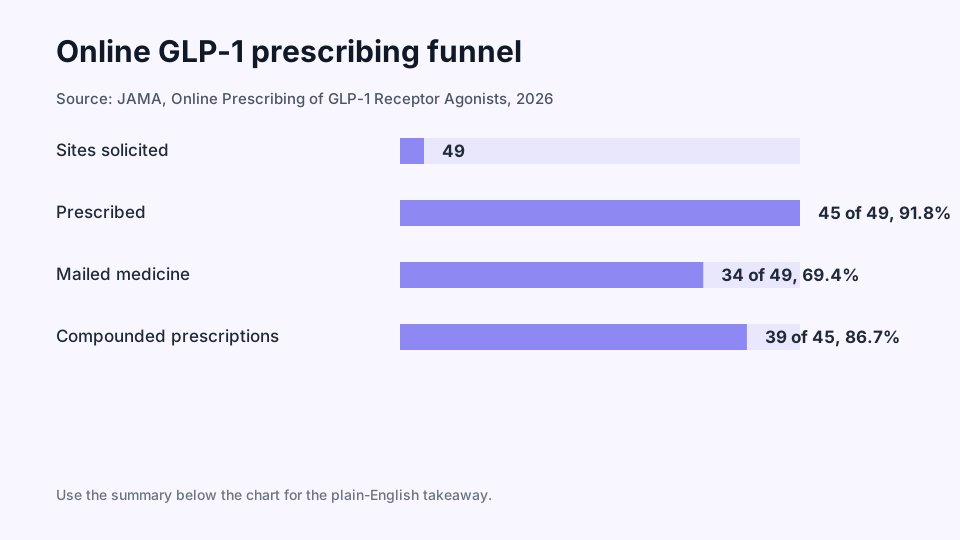
The funnel shows that many sites prescribed and shipped medicine, while compounded products accounted for most prescriptions issued.
| Measure | Result | What it means |
|---|---|---|
| Sites issuing a prescription | 45 of 49, 91.8% | Approval was common for the simulated eligible patient. |
| Sites mailing medication | 34 of 49, 69.4% | Many services combine prescribing with fulfillment. |
| Issued prescriptions that were compounded | 39 of 45, 86.7% | Most prescriptions were not FDA-approved branded products. |
| Sites requiring video | 13 of 49, 26.5% | Questionnaire-only routes were common. |
| Sites requiring phone | 3 of 49, 6.1% | Live voice contact was uncommon. |
Source: Source: JAMA, Online Prescribing of GLP-1 Receptor Agonists, 2026. One simulated patient and Connecticut-serving sites do not represent every patient or service.
Why compounded products need a direct question
Compounded semaglutide and tirzepatide are not FDA-approved generic medicines. FDA does not review compounded drugs for safety, effectiveness, or quality before they are marketed. During shortages, compounding rules and FDA enforcement discretion made access more complex. FDA later determined the tirzepatide injection shortage was resolved on December 19, 2024 and the semaglutide injection shortage was resolved on February 21, 2025. FDA ended the relevant enforcement-discretion periods for routine semaglutide copies in 2025. On March 3, 2026, FDA announced warning letters to 30 telehealth companies over illegal marketing of compounded GLP-1 medicines. Claims such as generic, same as, or FDA-approved pharmacy deserve careful questioning. FDA does not approve or license pharmacies or outsourcing facilities. A compounded medicine may arrive in a vial rather than a preset pen. FDA has reported hospitalizations connected with dosing errors involving compounded injectable semaglutide. Vials, syringes, differing concentrations, and instructions using units can create more room for confusion. Bring the package, written directions, and questions to a pharmacist rather than guessing.
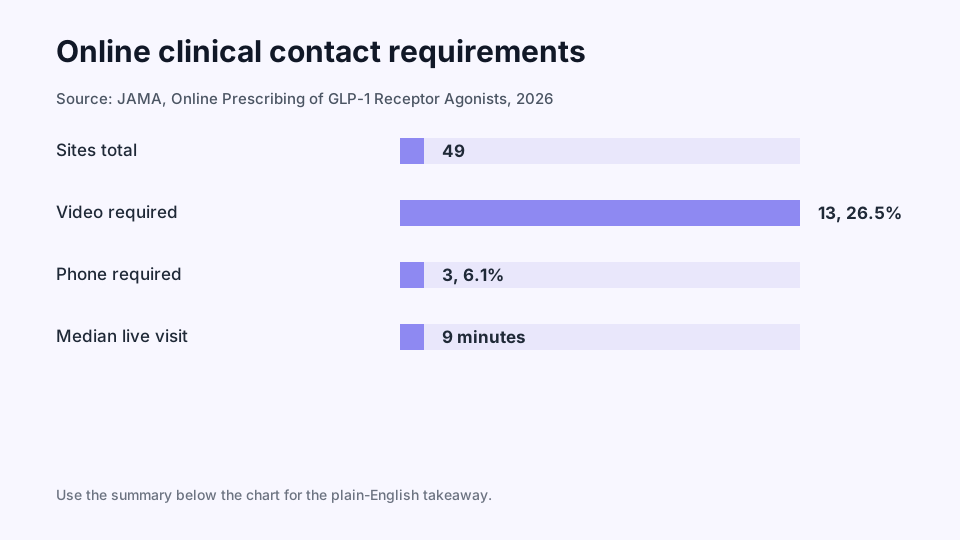
The chart shows that live contact was required by a minority of studied online sellers, which makes pre-enrollment questions about assessment and follow-up important.
Cost and coverage can decide whether treatment continues
A low first-month price does not answer the long-term affordability question. Official manufacturer offers can change, have eligibility terms, and may exclude a telehealth membership, shipping, laboratory testing, supplies, or follow-up. Ask for the all-in price at the dose expected later, not merely the price at treatment initiation. As checked August 23, 2026, Novo Nordisk listed Wegovy injection at $199 monthly for the first two fills at 0.25 mg or 0.5 mg, then $349 for listed standard doses. Wegovy HD was listed at $399 monthly. Eli Lilly listed Zepbound at $299 monthly for 2.5 mg, $399 for 5 mg, and $449 for 7.5 mg through 15 mg when refill conditions are met. Insurance remains uneven. KFF found that 19% of large employers offering health benefits covered GLP-1 medicines primarily for weight loss in 2025. In a national survey of people who had stopped a GLP-1 medicine, 31.3% obtained their first fill without insurance and 36.1% named cost as a reason for stopping. Those figures make it sensible to discuss a coverage denial or price change before treatment begins.
| Measure or offer | Figure | Practical use |
|---|---|---|
| Large employers covering weight-loss GLP-1s | 19% | Coverage is available through some jobs, not most. |
| First fill obtained without insurance | 31.3% | Many people start without a payer safety net. |
| Cost named as a stopping reason | 36.1% | Plan for ongoing affordability, not merely enrollment. |
| Wegovy introductory offer | $199 per month | First two listed low-dose fills only. |
| Wegovy listed standard doses | $349 per month | Official offer, not an all-in telehealth price. |
| Zepbound offers | $299 to $449 per month | Dose and refill terms apply. |
| Medicare GLP-1 Bridge | $50 per month | Only for eligible beneficiaries through December 31, 2027. |
Source: Sources: KFF 2025 Employer Health Benefits Survey; PubMed-indexed national discontinuation survey, 2026; Novo Nordisk and Eli Lilly official pricing pages; CMS Medicare GLP-1 Bridge materials. Offers and eligibility can change.
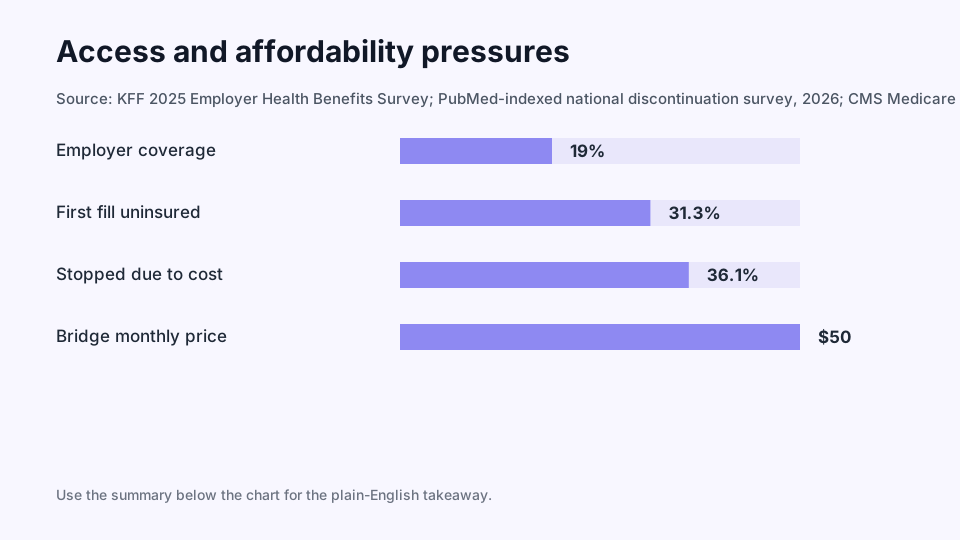
The measures show why access should be checked beyond an introductory price, while the Medicare Bridge offers a lower price only for eligible people.
Medicare access changed in 2026
CMS launched the Medicare GLP-1 Bridge on July 1, 2026. CMS says eligible Medicare Part D beneficiaries can obtain certain GLP-1 medicines for weight loss or weight maintenance for $50 monthly through December 31, 2027. The program operates outside the usual Part D coverage and payment process. It is not automatic coverage for everyone with Medicare. CMS says people already receiving a GLP-1 through Part D, or eligible for Part D coverage for a different approved use, may not qualify. Ask the prescriber and pharmacist whether the prescription belongs under the Bridge, your Part D plan, or neither route before assuming the $50 price applies.
What approved-medicine trials suggest about results
Trial results are useful for setting expectations, but they are averages under structured conditions with lifestyle support. They do not predict one person's result, establish that a compounded product works the same way, or compare medicines when the studies were not head to head. In STEP 1, adults with overweight or obesity without diabetes taking semaglutide 2.4 mg lost 14.9% of starting weight on average after 68 weeks, versus 2.4% with placebo. At 220 pounds, 14.9% is about 33 pounds. In SURMOUNT-1, tirzepatide 15 mg produced a 20.9% average loss after 72 weeks, versus 3.1% with placebo, or about 46 pounds from 220 pounds. The difference is useful for a broad comparison, but it should not be treated as a personal forecast. Diagnosis, other medicines, tolerability, access, and whether someone can stay on treatment all affect real-world experience. A clinician can help interpret whether an approved medicine's labeled use fits your history.
| Trial and medicine | Time | Average change | What 220 pounds looks like |
|---|---|---|---|
| STEP 1 semaglutide 2.4 mg | 68 weeks | -14.9% | About 33 pounds lost on average |
| STEP 1 placebo | 68 weeks | -2.4% | About 5 pounds lost on average |
| SURMOUNT-1 tirzepatide 15 mg | 72 weeks | -20.9% | About 46 pounds lost on average |
| SURMOUNT-1 placebo | 72 weeks | -3.1% | About 7 pounds lost on average |
Source: Sources: New England Journal of Medicine STEP 1 and SURMOUNT-1 trials. These were separate trials in adults without diabetes and are not a head-to-head comparison.
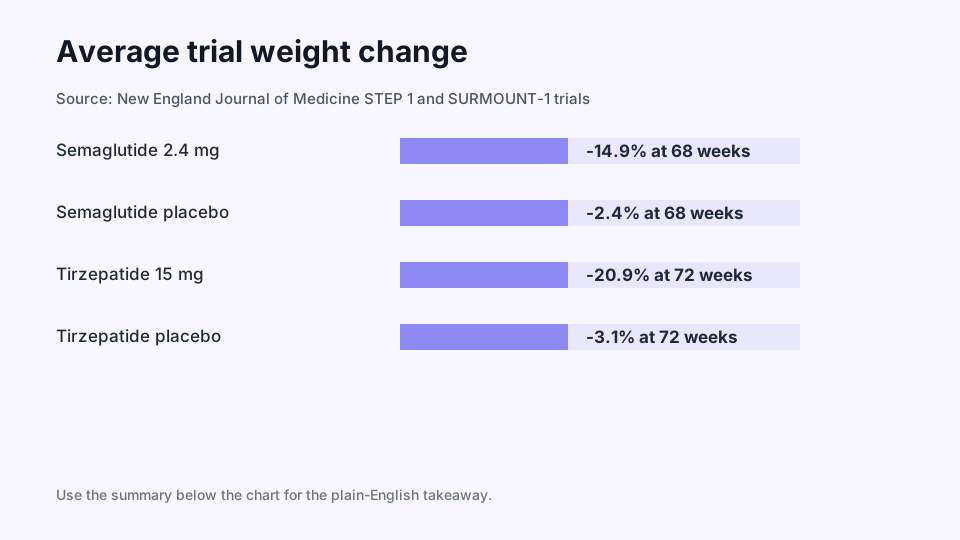
The chart compares averages from separate trials, not a head-to-head study, and helps put expected timeframes and scale of weight change into context.
Maintenance and stopping deserve an early conversation
Treatment duration is a practical issue, especially when the medicine is paid for monthly. In the STEP 1 extension, participants regained substantial weight after semaglutide withdrawal. In SURMOUNT-4, people switched from tirzepatide to placebo regained weight during the following year, while people who continued treatment maintained and added to earlier loss. That does not mean a person can never stop. It means a plan should account for maintenance, affordability, side effects, supply interruptions, and the possibility that needs change. In the national survey, 54.6% of respondents who had stopped did so within six months and 79.7% within 12 months. Cost, side effects, and lack of insurance were among the reasons reported. HbA1c, also called A1c, is a blood test that estimates average blood sugar over roughly the prior two to three months. It may be relevant for people with diabetes or prediabetes. Keep your prescriber involved in decisions about medicines, symptoms, laboratory results, and changes in access.
Questions to ask before you pay
Ask what exact medicine is being prescribed, including its generic name, brand name when applicable, form, and FDA approval status. Ask which pharmacy will fill it, where that pharmacy is licensed, and whether the medicine arrives as a preset pen or vial. Request the full monthly amount including clinical fees, medicine, shipping, laboratory work, supplies, and refills. Ask who handles prior authorization, whether paperwork carries a fee, and what happens after an insurance denial. Find out how to reach the clinician for side effects, refill delays, or a decision to pause treatment. You should be able to obtain visit notes, prescription details, laboratory orders and results, and pharmacy information. Track the medicine name and source, fill dates, out-of-pocket cost, side effects, and any weight or laboratory trend you choose to monitor. Lina is a GLP-1 companion app for people using Wegovy, Mounjaro, Ozempic, Zepbound, Saxenda, and related medicines. It helps users track doses, side effects, meals, weight, protein, hydration, and habits in one place. It is a wellness tracking companion, not a medical device or a substitute for medical advice. Seek urgent medical help for severe or persistent symptoms rather than waiting for an app message. This is particularly important if you have a compounded injectable product and are unsure how to measure a dose.
Methodology
- Source priority was FDA and CMS materials, FDA-approved product information, peer-reviewed studies, PubMed-indexed research, official manufacturer pricing pages, and KFF survey data.
- Sources and official offers were last checked August 23, 2026.
- Affiliate pages, telehealth marketing claims, pharmacy blogs, peptide sellers, social-media claims, generic approval trackers, and unverified price lists were excluded or treated cautiously.
- The evidence cannot determine whether a particular person qualifies, whether a specific clinician's care is appropriate, whether insurance will approve a prescription, or what an individual's benefit or side effects will be.
Recent updates
- Reviewed FDA, CMS, manufacturer, peer-reviewed, and health-policy sources.
- CMS launched the Medicare GLP-1 Bridge for eligible beneficiaries.
- FDA announced warning letters to 30 telehealth companies over illegal marketing of compounded GLP-1 medicines.
Download the data
Download the source-reviewed figures used for online prescribing, access, pricing, and trial comparisons.