Introduction
Wegovy cost statistics for the US in 2026, including list price, self-pay offers, Medicare Bridge access, coverage rules, outcomes, and safety.
Wegovy facts at a glance
- $1,349.02 per package - Published list price
- $199 monthly for first 2 stated fills - Standard injection introductory offer
- $349 monthly - Standard injection offer after introduction
- $399 monthly - Wegovy HD published self-pay price
- $149 monthly - Pill offer for 1.5 mg and 4 mg
- As little as $25 monthly - Commercial savings floor
- $50 monthly for eligible people - Medicare GLP-1 Bridge copay
- 14.9% at 68 weeks - STEP 1 average weight change
What you may actually pay
NovoCare lists Wegovy at $1,349.02 per package for the pill, standard injection pen, and Wegovy HD pen. That is the manufacturer list price before plan rules, rebates, copays, or savings offers. It should not be treated as a dependable estimate of what a pharmacy will charge you. For an uninsured person using the published self-pay route, the standard injection offer is $199 monthly for the first two specified 0.25 mg or 0.5 mg fills for new participants, then $349 monthly for listed standard injection doses. If $349 stayed unchanged for a year, it would be $4,188. That multiplication is a planning example, not a promise that the offer will continue. Wegovy HD is listed at $399 monthly after its introductory period, or $600 more over twelve months than $349 monthly. The daily pill is listed at $149 monthly for 1.5 mg and 4 mg under stated terms. NovoCare says the 4 mg $149 offer ends August 31, 2026, after which the stated amount is $199 monthly unless the program changes.
| Route or product | Published figure | What to check |
|---|---|---|
| Wegovy list price | $1,349.02 per package | Pharmacy cash price may differ from list price |
| Injection introductory self-pay offer | $199 monthly for 2 fills | Stated 0.25 mg and 0.5 mg fills; deadline December 31, 2026 |
| Standard injection self-pay offer | $349 monthly | Offer eligibility and current terms |
| Wegovy HD self-pay offer | $399 monthly | Higher than stated standard injection offer |
| Pill offer for 1.5 mg and 4 mg | $149 monthly | 4 mg offer ends August 31, 2026 |
| Eligible commercial savings | As little as $25 monthly | $100 monthly maximum savings and government exclusion |
| Medicare GLP-1 Bridge | $50 monthly | Eligibility and program end date December 31, 2027 |
Source: Sources: NovoCare Wegovy medicine and savings materials; CMS Medicare GLP-1 Bridge. Checked August 15, 2026. Published offers are not guaranteed pharmacy prices.
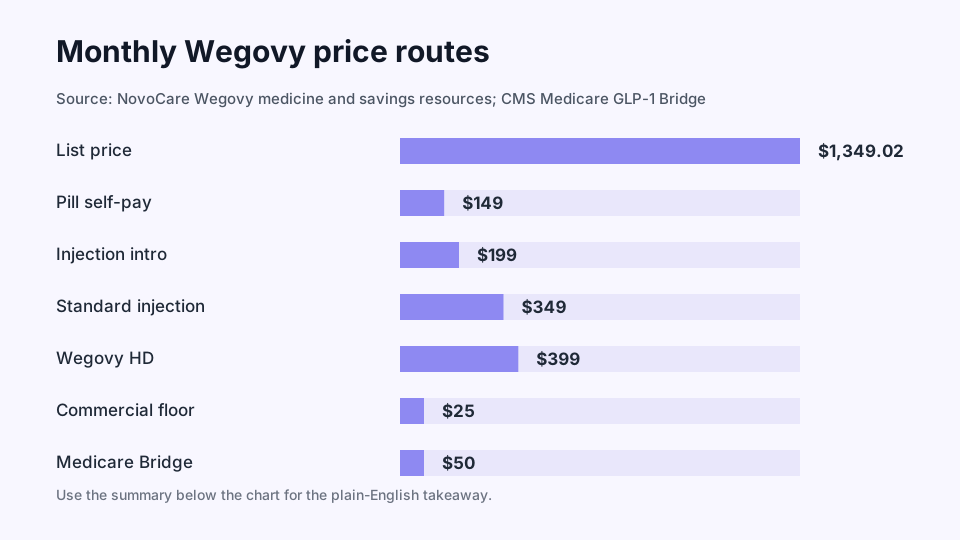
Published monthly amounts vary sharply by route, and the lower figures require stated eligibility or offer terms.
Coverage and Medicare access
With commercial insurance, the practical question is whether your plan covers Wegovy for your diagnosis and whether it requires prior authorization. Prior authorization means the prescriber's office sends clinical information to the insurer before the plan will pay. NovoCare says many plans require it and that a request can take up to 10 business days. The advertised commercial savings offer says eligible people may pay as little as $25 monthly. That phrase is a floor, not a standard copay. The offer has a $100 monthly maximum savings limit and excludes government beneficiaries. Medicare works differently. Wegovy can be covered through normal Medicare Part D for certain FDA-approved uses, including cardiovascular-risk reduction in qualifying adults with established cardiovascular disease and overweight or obesity. The Medicare GLP-1 Bridge is a separate temporary route for eligible Part D beneficiaries, with a $50 monthly copay through December 31, 2027. CMS says Bridge payments operate outside ordinary Part D payment and deductible rules. The $50 does not count toward the Part D deductible or true out-of-pocket spending threshold. Medicaid coverage varies by state and managed-care plan, so a state plan or insurer must confirm the actual benefit.
What the trial results can mean
Glucagon-like peptide-1, or GLP-1, medicines act on a hormone pathway involved in appetite and blood sugar. Wegovy contains semaglutide. In STEP 1, a 68-week trial of adults with overweight or obesity without diabetes, people using weekly 2.4 mg Wegovy with lifestyle support lost 14.9% of starting body weight on average, compared with 2.4% with placebo. For someone starting at 235 pounds, 14.9% is about 35 pounds on average over roughly a year and four months. It cannot predict one person's result. Cost, side effects, other health conditions, supply, and insurance changes can all affect whether someone stays on treatment. In a trial involving people with type 2 diabetes, average loss with 2.4 mg was 9.6% at 68 weeks, versus 3.4% with placebo. Comparing these groups matters because diabetes status can change trial averages. Wegovy HD is a 7.2 mg weekly injection approved in March 2026. In adults with obesity without type 2 diabetes, the FDA label reports 18.8% average loss at 72 weeks with 7.2 mg, compared with 15.5% with 2.4 mg in the same study. That 3.3-percentage-point difference is meaningful at a population level, but it does not settle what is tolerable, covered, or appropriate for a particular person.
| Study group | Treatment result | Timeframe | Practical meaning |
|---|---|---|---|
| Adults without diabetes in STEP 1 | 14.9% average loss with 2.4 mg | 68 weeks | About 35 pounds from a 235-pound starting weight, on average |
| STEP 1 placebo group | 2.4% average loss | 68 weeks | Shows the difference seen alongside lifestyle support |
| Adults with type 2 diabetes | 9.6% average loss with 2.4 mg | 68 weeks | Average result was lower in this trial group |
| Adults without diabetes in Wegovy HD study | 18.8% with 7.2 mg | 72 weeks | 3.3 percentage points more than 2.4 mg in the same study |
| Adults without diabetes in Wegovy HD study | 15.5% with 2.4 mg | 72 weeks | A like-for-like comparator within that study |
Source: Source: FDA Wegovy prescribing information revised June 2026; STEP 1 trial publication. Trial averages do not predict an individual outcome.
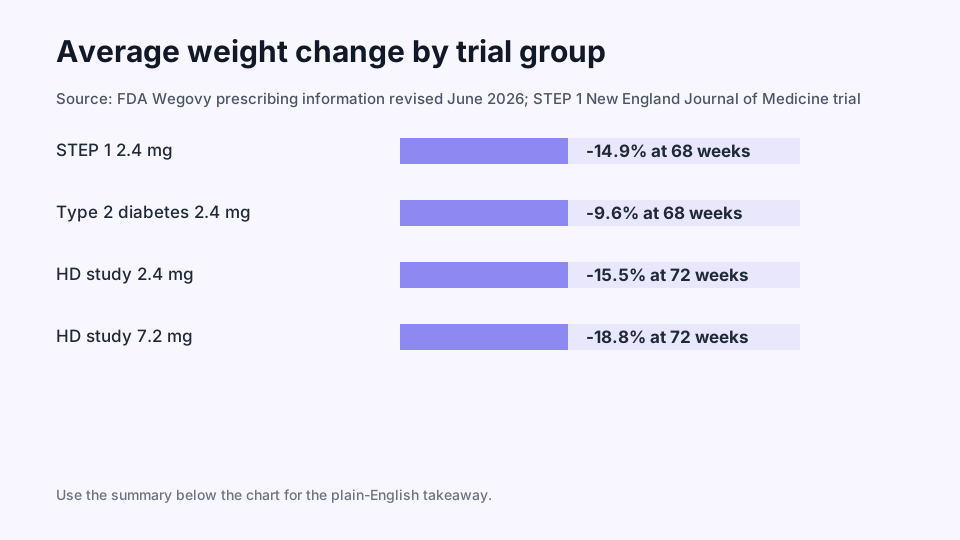
Results differ by trial population and dose, so a headline percentage should not be treated as a personal forecast.
Maintenance and stopping
Cost decisions should include what may happen if treatment stops. In a follow-up study after semaglutide withdrawal, participants regained about two-thirds of their earlier weight loss within one year on average. Regain is common and is not a personal failure. Before starting or restarting, it is reasonable to ask how long coverage is approved for, what happens when a savings offer expires, and what the plan would be if you stop. Those questions matter as much as the first-month quote. A clinician can discuss medical options, while a pharmacist can help clarify the presentation, refill timing, and interactions.
Safety and daily routine
The current label includes a once-weekly injection and a once-daily oral tablet. The injection is used once weekly on the same day each week, with or without meals. The tablet is taken once daily on an empty stomach with water, followed by at least 30 minutes before food, other drinks, or oral medicines; ask a clinician or pharmacist for instructions for the formulation prescribed to you. Common adverse reactions in the label include nausea, diarrhea, vomiting, constipation, abdominal pain, headache, fatigue, indigestion, and dizziness. The label also warns about pancreatitis, gallbladder disease, dehydration-related kidney injury, severe gastrointestinal reactions, low blood sugar with insulin or certain diabetes medicines, allergic reactions, and some eye risks for people with type 2 diabetes. Wegovy is not a substitute for urgent care. Ask the prescribing team what symptoms should prompt a call, urgent care, or emergency care based on your health history. Also ask for a review of your other medicines because semaglutide can delay stomach emptying.
| Item | FDA-label information | Why it matters |
|---|---|---|
| Nausea and gastrointestinal symptoms | Nausea, diarrhea, vomiting, constipation, abdominal pain, and indigestion are common adverse reactions | Symptoms can affect daily routines and whether treatment is continued |
| Dehydration-related kidney injury | Listed warning | Vomiting or diarrhea may need timely medical attention |
| Pancreatitis and gallbladder disease | Listed warnings | Discuss personal history and symptoms with a clinician |
| Low blood sugar | Risk rises with insulin or certain diabetes medicines | Other medicines may need review |
| Eye risks in type 2 diabetes | Listed warning | People with diabetes should ask what monitoring is appropriate |
Source: Source: FDA Wegovy prescribing information revised June 2026. The table describes label information and does not replace individual medical assessment.
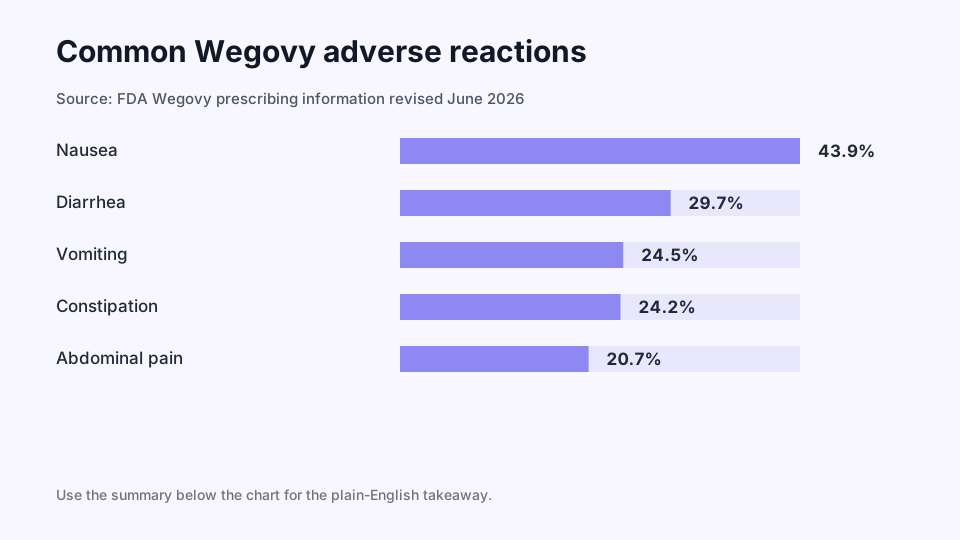
Gastrointestinal symptoms are common in the FDA-label trial table and can affect whether a person can continue treatment.
Dates that can change your options
The March 2024 cardiovascular indication matters because it may affect access through Medicare Part D for qualifying people. In March 2026, FDA approved Wegovy HD. The June 2026 label revision includes injection, pill, and HD presentations. The Medicare GLP-1 Bridge began July 1, 2026. Its scheduled end is December 31, 2027. Manufacturer offer deadlines are nearer: the stated 4 mg tablet $149 offer ends August 31, 2026, and the two-fill $199 injection introductory offer has a stated deadline of December 31, 2026.
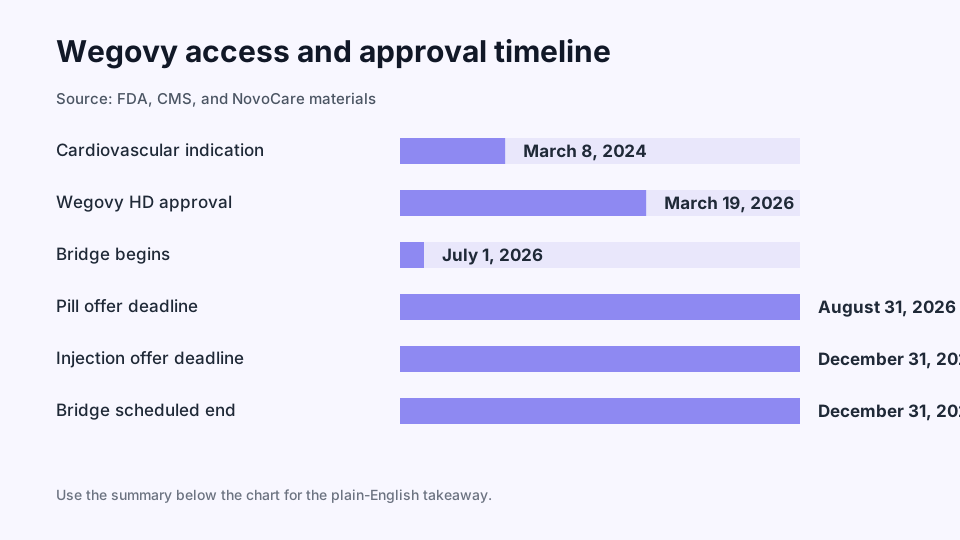
FDA decisions, manufacturer offer deadlines, and temporary Medicare access have different dates and should be checked separately.
Questions to take to a clinician or pharmacist
Ask what FDA-approved reason Wegovy is being prescribed for in your case and whether your plan covers that use. Ask who submits prior authorization, how you will learn the decision, what documentation is needed, and when approval must be renewed. Ask the pharmacy what you will pay after deductible, copay, coinsurance, and any savings offer. Ask which presentation was prescribed, whether your current medicines need review, and what plan makes sense if you cannot tolerate treatment, lose coverage, or decide to stop. Avoid assuming compounded semaglutide is the same as FDA-approved Wegovy. FDA says compounded drugs are not FDA approved and reports concerns about dosing errors, salt forms, and adverse events. FDA had received 990 adverse-event reports associated with compounded semaglutide as of May 31, 2026; reports do not prove causation for every event.
Methodology
- Source priority was FDA prescribing information and approval notices, CMS program materials, ClinicalTrials.gov and peer-reviewed trials, then official NovoCare cost, coverage, and savings pages.
- Sources and offer details were checked August 15, 2026.
- Affiliate pages, coupon aggregators, pharmacy marketing blogs, social posts, peptide sellers, and speculative price or approval trackers were excluded or treated cautiously.
- Manufacturer savings offers, Medicare eligibility, Medicaid access, and final pharmacy charges can change and depend on personal plan rules.
- The guide is source-reviewed and not clinically reviewed by a named clinician. It cannot determine medical suitability, individual safety, insurance approval, or final out-of-pocket cost.
Update history
- Published with current FDA label, NovoCare offers, and CMS Medicare GLP-1 Bridge details.
- CMS Medicare GLP-1 Bridge launch added to the monitored access timeline.
- FDA June 2026 Wegovy label revision added to the monitored formulation information.
Data download
Download the published figures used for list price, self-pay offers, Bridge copay, trial outcomes, and dated milestones. Values are checked against the listed sources and are not individualized price estimates.